Wisnovsky Lab
Wisnovsky Lab
Email Simon (opens in a new tab) @Wisnovsky_Lab on X (opens in a new tab)

Functional glyco-genomics

The Wisnovsky Lab is a chemical biology and functional genomics laboratory housed in the Faculty of Pharmaceutical Sciences at the University of British Columbia, Vancouver. Our work integrates molecular design, functional genetics, glycobiology and immunology to advance understanding of human disease.

Faculty of Pharmaceutical SciencesUniversity of British ColumbiaVancouver, BC
The UBC Pharmaceutical Sciences building, a stack of glass cubes lit at dusk
Pharmaceutical Sciences Building, UBC Vancouver

Research

All research

Lab news

All news

    Recent publications

    All publications

      Join the lab

      We are actively recruiting creative and motivated researchers to join our group: graduate students, postdocs, research assistants and undergraduates.

      Functional glyco-genomics

      All living cells are coated with a dense layer of carbohydrate molecules called glycans. The Wisnovsky lab uses cutting-edge functional genomic screening tools to better define the molecular function of these glycans and identify new therapeutic targets for the treatment of disease.

      Schematic of glycans attached to proteins at the cell surface, drawn with standard glycan symbols
      Glycans decorate proteins and lipids across the cell surface.

      The cancer glyco-genomic code

      Cancer cells radically alter their cell surface glycans during tumour development. Cancer-associated glycan structures often act as signals that shut off immune activity, helping cancer cells hide from the immune system.

      The Wisnovsky lab is using CRISPR knockout (CRISPR KO) and CRISPR interference (CRISPRi) screening techniques to identify the molecular pathways in cancer cells that drive these fundamental changes in cellular glycosylation. We expect our work to identify new cancer-specific vulnerabilities that can be targeted for tumour immunotherapy.
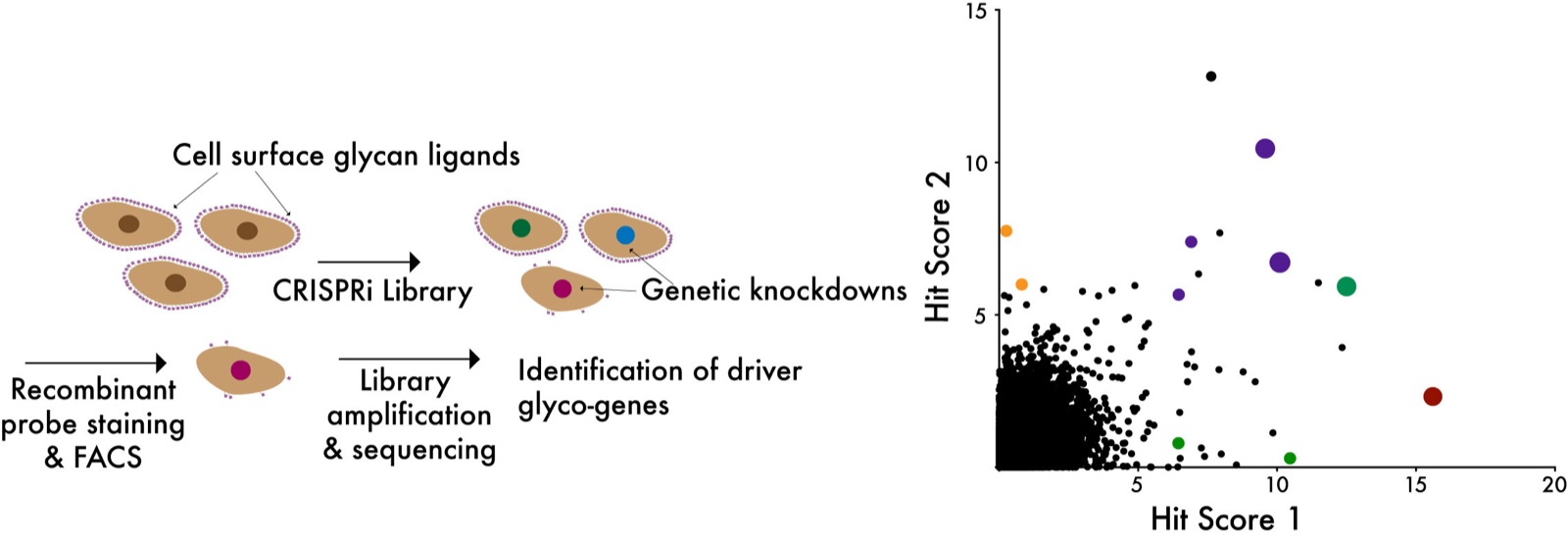
      Workflow of a pooled CRISPR screen for regulators of cancer cell glycosylation

      Defining new ligands for orphan glycan-binding receptors

      Human immune cells express hundreds of glycan-binding receptors that transmit specific intracellular signals upon binding to specific glycosylated ligands.

      The Wisnovsky lab uses high-throughput CRISPR activation (CRISPRa) screening, along with an array of targeted biochemical techniques, to define the complex glycoprotein structures that bind to receptors of interest. Understanding these ligand-receptor interactions can help us build new tools and strategies for therapeutically modulating the immune system.

      Diagram of an immune-cell glycan-binding receptor engaging a glycoprotein ligand

      New technologies for glycome-wide screening

      Hundreds of distinct glycan structures are attached to thousands of different protein scaffolds on the cell surface. The Wisnovsky lab is building new CRISPR-based technologies that will allow us to directly screen the function of these glycans in a pooled, high-throughput manner. We hope these tools will create new opportunities in translational glycoscience.

      Concept figure of CRISPR-based glyco-editing across the cell surface

      Publications

      Papers and preprints from the lab, plus Simon’s postdoctoral and doctoral work.

      People

      Portrait of Simon Wisnovsky

      Simon Wisnovsky, PhD

      Principal InvestigatorAssistant Professor, Faculty of Pharmaceutical Sciences

      Prof. Simon Wisnovsky grew up in Montréal, Quebec and obtained his B. Sc. in Biochemistry from McGill University. He completed his PhD in Prof. Shana Kelley’s lab at the University of Toronto, where he developed new chemical-genetic screening methods to study the cellular DNA damage response.

      In 2017 Simon joined Prof. Carolyn Bertozzi’s lab at Stanford University as a CIHR Banting Postdoctoral Fellow. There, he applied his expertise in genomic screening to identify ligands for a class of glycan-binding immune receptors emerging as targets for cancer immunotherapy.

      Dr. Wisnovsky started his own research group at UBC in July 2021. The Wisnovsky lab focuses on developing and applying new functional genomic screening platforms for studying glycan function. Their work aims to deepen understanding of cellular glycosylation and to identify molecules that can be targeted for therapeutic development.

      • 2021–Principal Investigator, University of British Columbia
      • 2017–2021CIHR Banting Postdoctoral Fellow, Stanford University (Bertozzi lab)
      • PhDUniversity of Toronto (Kelley lab)
      • BScBiochemistry, McGill University

      Postdoctoral fellows & staff

        Graduate students

          Lab life

          Retreats, celebrations and conference trips

          Alumni

          NameIn the labNow

          News

          Papers, comps, defences and other milestones from the lab.

          Join us

          We are actively recruiting creative and motivated researchers to join our group! Wisnovsky lab trainees can expect to receive training in basic molecular biology and immunology techniques as well in cutting-edge areas like high-throughput functional genomics and next-generation sequencing. We aim to equip trainees with the scientific, communication and leadership skills needed to achieve all their goals.

          • Graduate students

            Prospective graduate students should send a copy of their CV and undergraduate transcripts to Simon (opens in a new tab). Depending on interest, they should also consult the UBC Pharmaceutical Sciences Masters (opens in a new tab) and/or PhD (opens in a new tab) program application timeline and requirements.

          • Postdoctoral researchers

            Prospective postdoctoral researchers interested in joining the group should send Simon (opens in a new tab) a CV, cover letter and contact information for three references. We especially welcome applications from researchers with prior experience in genetic screening and/or immunology.

          • Research assistants

            We are also happy to consider research assistant positions (e.g., co-op work terms or summer research projects through the UBC Pharm Sci SSRP (opens in a new tab)) for senior undergraduates interested in an intensive, full-time research experience prior to applying to graduate or medical school. Candidates for these positions must have prior research experience in a biomedical setting and be competitive for external scholarships such as the NSERC USRA (opens in a new tab).

          • Junior undergraduates

            Finally, we welcome applications from motivated junior undergraduate students looking to gain lab experience through part-time WorkLearn (opens in a new tab) positions and/or Directed Studies projects. We typically do not take on students for unpaid volunteer positions. Please email Simon (opens in a new tab) directly to learn about any upcoming possible opportunities.

          The Wisnovsky lab is committed to maintaining a diverse, inclusive and collegial working environment. We welcome researchers of all races, ethnicities, sexual orientations and gender identities.